
The Most Unhinged True Stories from Ivy League Campuses
L
By Lucas Rollins on October 10, 2026
The Ivy League is usually associated with selective admissions, famous professors, historic libraries, and students carrying laptops while walking suspiciously fast.
Spend enough time digging into the histories of these universities, though, and a much stranger picture appears.
These campuses have produced secret societies, bizarre traditions, legendary pranks, underground tunnels, enormous snowballs, and at least one story involving students attempting to move an entire building.
Some stories have become exaggerated through decades of retelling. Others are surprisingly well documented. Either way, Ivy League history is considerably weirder than the brochures suggest.
Yale has a secret society with its own mysterious tomb
Secret societies exist at several universities, but Yale’s Skull and Bones has become practically synonymous with the concept.
Founded in 1832, the society has counted prominent political and business figures among its members. Its headquarters is a large, mostly windowless building on Yale’s campus known simply as “the Tomb.”
That alone sounds like something written for a college thriller.
Membership traditionally involves selecting a small group of Yale students, while the society’s private activities have inspired generations of rumors. The secrecy surrounding the organization has helped turn Skull and Bones into something much larger in popular culture than an ordinary student club.
The funny part is that Yale students can walk past the Tomb while heading to class.
At most universities, the mysterious stone headquarters of a centuries-old secret society would be the strangest building in town. At Yale, it’s part of the neighborhood.
Princeton students once tried to steal a cannon
College rivalries can get intense.
Princeton and Rutgers took things to another level.
A large cannon associated with the two schools became the center of a long-running rivalry during the nineteenth century. Princeton students eventually brought the cannon to Princeton, where it became part of campus lore. Rutgers students later attempted to recover it.
The story became known as the Cannon War.
Princeton eventually buried the cannon behind Nassau Hall, leaving only part of it visible above the ground. A smaller cannon nearby also became part of the rivalry.
Over the years, students from the rival institutions repeatedly painted and targeted the cannons.
Most college rivalries involve sports scores.
This one involved artillery.
Harvard has a statue everyone rubs for luck
Visitors to Harvard Yard frequently encounter the statue of John Harvard, and many stop to rub the left shoe.
The shoe is noticeably shinier than the rest of the statue because generations of tourists have touched it, often believing that doing so brings good luck.
There are several amusing problems with this.
The statue is commonly called the “Statue of Three Lies.” The inscription describes John Harvard as the university’s founder, even though Harvard was established by the Massachusetts colonial government and later named after him. The date on the statue also creates historical complications, and the sculptor didn’t actually know what John Harvard looked like because no confirmed portrait of him existed.
So the person represented by the statue isn’t necessarily John Harvard at all.
Thousands of visitors nevertheless continue rubbing the shoe of a man who may not look anything like the person they think he is.
Tradition rarely lets facts ruin a good photo opportunity.
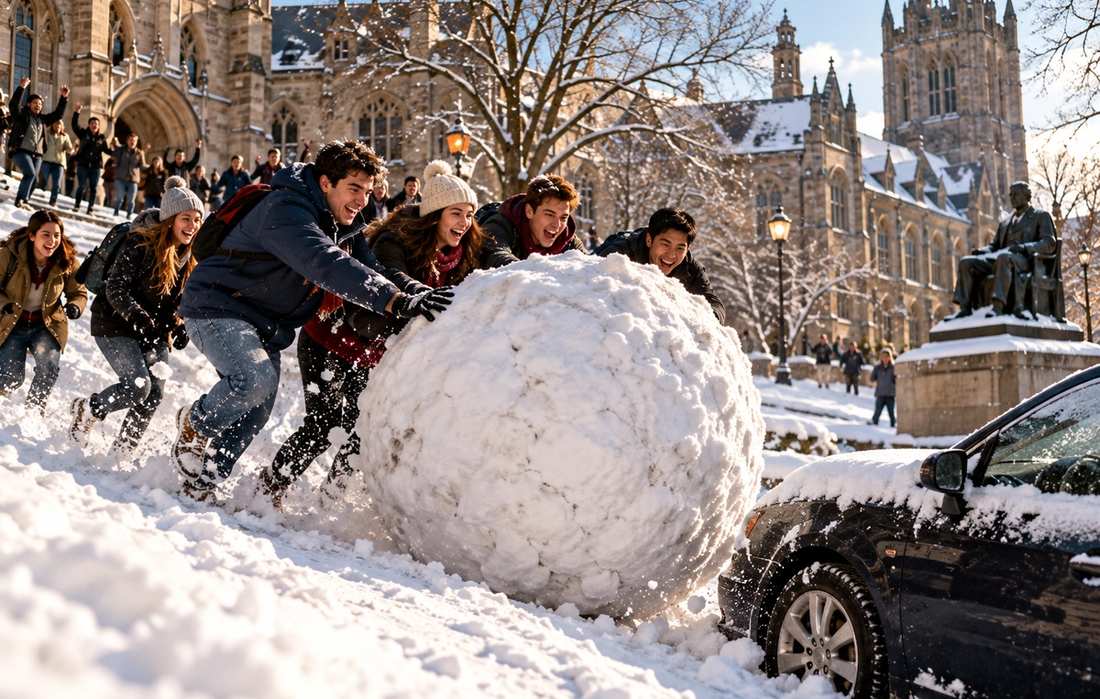
Cornell once had a giant snowball roll into the street
Cornell University sits in Ithaca, New York, where winter is taken very seriously.
That environment helped produce one of the more ridiculous episodes in campus history.
In 1997, students created an enormous snowball on campus. Estimates placed its weight in the hundreds of pounds. At some point, gravity took over.
The snowball rolled downhill, crossed campus, and eventually collided with a parked car.
Nobody was seriously hurt, but the event became one of those college stories that sounds invented until you discover that people actually documented it.
Building an enormous snowball is one thing.
Building one on a hill without fully considering what hills do to round objects is another.
Dartmouth turned winter into an entire personality
Dartmouth is famous for its Winter Carnival, a tradition dating back to the early twentieth century.
The event has included skiing, skating, competitions, parties, and enormous snow sculptures constructed on the campus green.
And “snow sculpture” doesn’t mean a slightly ambitious snowman.
Over the decades, Dartmouth students have created massive structures, including castles, animals, characters, and elaborate scenes that required huge amounts of snow and student labor.
Some historical sculptures towered over the people standing beside them.
There’s something wonderfully collegiate about responding to a freezing New Hampshire winter not by staying indoors but by deciding to construct architecture out of snow.
Princeton has a tradition involving a screaming crowd
Princeton has another tradition that is much less complicated than stealing cannons.
Students scream.
The tradition is known as the Holder Howl, associated with students letting out a collective scream from their dormitories during stressful periods around exams.
There’s no complicated equipment, historical costume, or secret ritual required.
You simply reach the point in the semester when academic pressure becomes overwhelming and yell.
Of all the unusual Ivy League traditions, this may actually be the easiest for students everywhere else to understand.
Sometimes wellness looks like meditation.
Sometimes it apparently looks like an entire residential college screaming into the night.
Brown students celebrate by getting extremely muddy
Brown University has its own collection of campus traditions, including Spring Weekend and various events that have changed over generations.
Like many old universities, Brown has accumulated stories and rituals that blur the line between official tradition and student-created chaos.
That distinction matters because college folklore has a tendency to grow.
One student tells another a story. Ten years later, the details become better. Fifty years later, nobody is entirely sure which part actually happened.
The same phenomenon exists across Ivy League campuses.
Stories about tunnels, pranks, secret societies, rivalries, and strange initiation rituals often contain a mixture of documented history and embellishment.
And sometimes the legend becomes almost as important as the original event.
Ivy League students are still college students
It’s easy to imagine elite universities as intensely serious places where everyone spends Saturday night discussing philosophy in a library.
Their histories suggest otherwise.
Students at prestigious universities have spent generations doing many of the same things students everywhere do: inventing pointless traditions, competing with rival schools, pulling pranks, making questionable decisions, and turning ordinary campus objects into sacred institutions.
The buildings may be Gothic. The libraries may contain priceless manuscripts. The alumni list may include presidents, Nobel laureates, CEOs, writers, and Supreme Court justices.
But give college students enough snow and apparently someone will still build a giant ball and accidentally send it downhill toward a car.
Prestige changes a lot of things.
College students being college students does not.

How to Stop Procrastinating (Backed by Psychology)
You know the assignment is due Friday. You’ve known about it for two weeks. You even opened the document three days ago. And yet, somehow, it’s Thursday night and you’re suddenly very interested in reorganizing your desk, answering old messages, and researching something that has absolutely nothing to do with the assignment.
Legacy Park|1 week ago

How to Build Habits That Actually Last
Lian Everett|1 week ago

The Difference Between Discipline and Motivation
Joey Zimmerman|1 week ago

How to Become a Better Decision Maker
Noah Shepard|1 week ago

The Two-Minute Rule That Solves Procrastination
Lucas Rollins|1 week ago

How to Read More Books This Year
Colton Watts|1 week ago
Read More
The Real Difference Between a Job, a Career, and a Calling
Legacy Park|

The Real Difference Between Free and Paid AI Tools
Joey Zimmerman|

The Quiet Loneliness of College (And What Actually Helps)
Legacy Park|

Why “Finding Yourself” Takes Longer Than Anyone Told You
Lian Everett|

The Real Difference Between Being Smart and Being Educated
Lian Everett|

Why Some Students Peak in College (And Others Don’t)
Noah Shepard|

The Cultural Power of the College Years (For Better or Worse)
Lucas Rollins|

Why the Best Advice You Get in College Rarely Comes from a Professor
Colton Watts|

How to Use AI to Study Smarter (Not Just Faster)
Legacy Park|

The Apps Every Student Should Actually Download
Lian Everett|

How to Take Better Class Notes with Just Your Laptop
Joey Zimmerman|

How to Back Up Your Files (Before Your Laptop Dies Mid-Semester)
Lucas Rollins|

How to Spot AI-Generated Content Even When It’s Good
Colton Watts|
The Weirdest College Traditions Around the World
Joey Zimmerman|

The Movies Every College Student Should See at Least Once
Joey Zimmerman|

The Best Ways to Actually Enjoy a Weekend Off Campus
Joey Zimmerman|

The Games That Every Dorm Room Ends Up Playing
Joey Zimmerman|
The Most Unhinged True Stories from Ivy League Campuses
Lucas Rollins|

The Books That Are Actually Fun to Read (Not Just Required)
Colton Watts|

How to Stop Procrastinating (Backed by Psychology)
Legacy Park|